Concept demonstrationRestaurant website
Juniper Kitchen
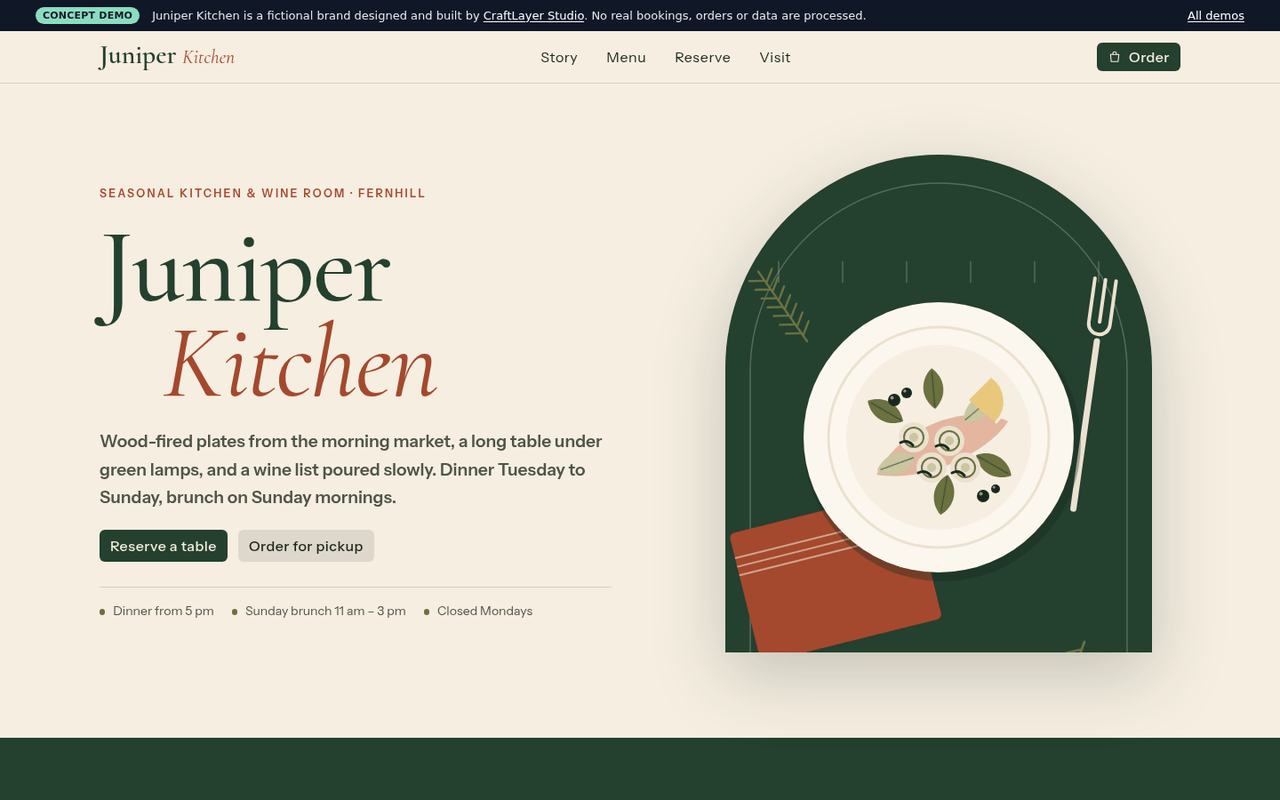
Fictional restaurant brand: filterable menu, mock order cart and validated reservations.
Industries / Restaurants & hospitality
Most restaurant visits start on a phone: someone checks the menu, the opening hours and whether there is a table. We design menus that are quick to scan and filter, and ordering and reservation flows that only offer times you are actually open.
What the site needs
Venues that want menus, ordering and reservations to be quick on mobile and easy to update.
Concept demo
A working website for a fictional business, so you can click through the patterns before we talk.
Concept demo. Juniper Kitchen is a fictional brand built by CraftLayer Studio to demonstrate design and engineering patterns. It is not a real business or a client project, and its forms do not send data anywhere.
Fictional restaurant brand: filterable menu, mock order cart and validated reservations.
The full source is public: read the Juniper Kitchen code on GitHub(opens in new tab).
What you receive
The same standards apply to every project. Each one is something you can check in our public repositories.
A static export where the content allows it, so hosting stays cheap and simple; server rendering only where a feature needs it. This site and every concept demo are static exports.
Layouts are checked at a 320px-wide viewport for horizontal scrolling and clipped content, as the concept demos are.
Keyboard testing, visible focus, labelled forms with error summaries, and automated axe-core checks against WCAG 2.2 AA before handover.
Unit tests for pricing, filtering, scheduling and form validation, run in CI with linting and type checks on every change.
Unique titles and descriptions, canonical URLs, a sitemap, robots.txt and structured data that only states facts.
The source lives in a Git repository you can access throughout the project, with handover notes and a walkthrough at launch.
Other industries
Next step
Tell us what you are working on. You will hear back from the founder directly, usually with questions before a quote.